

Customer story
FrieslandCampina: ‘With these tanks, we take a big step towards fully self-sufficient water use’
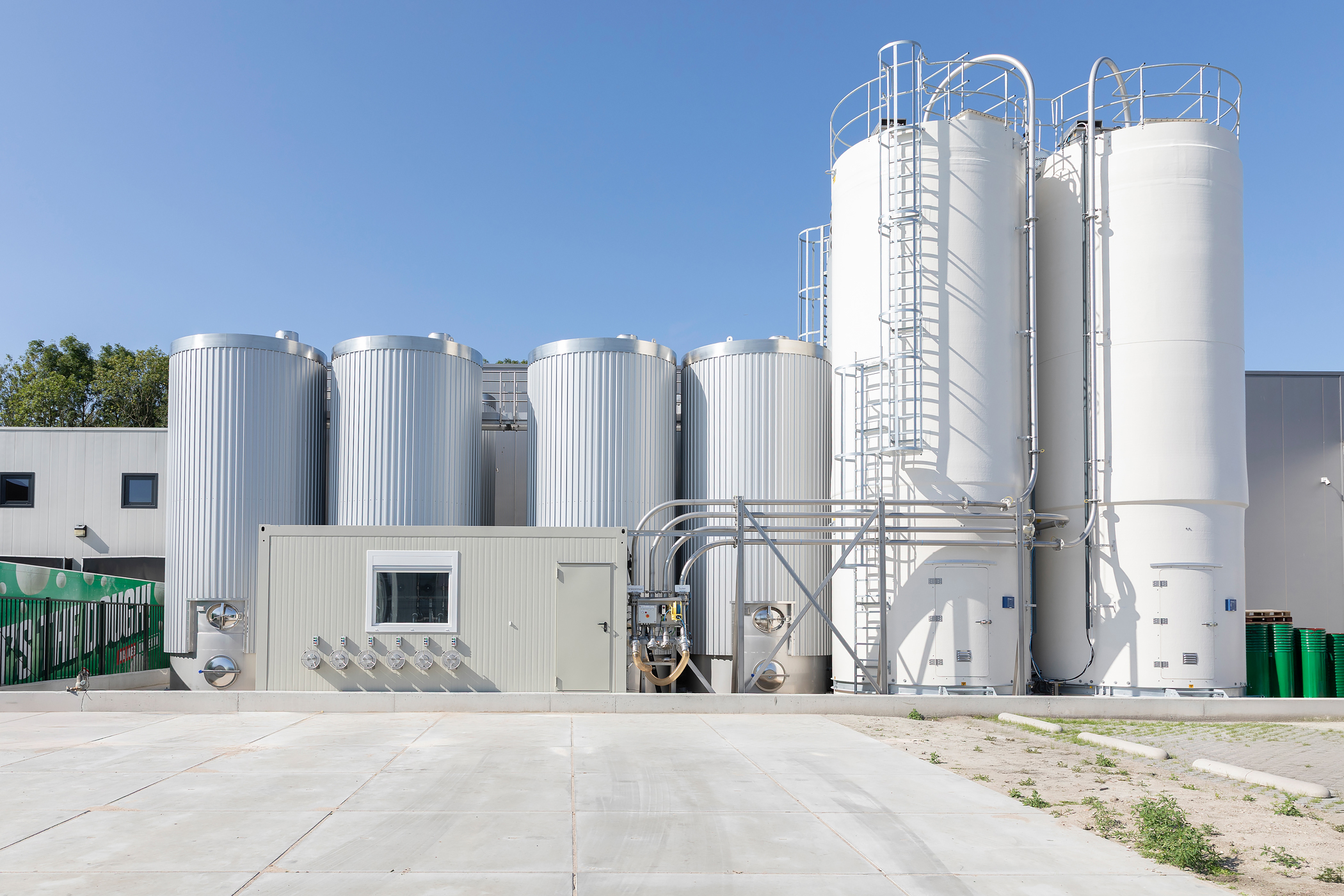
Gpi Tanks supplies two 200 m³ stainless steel water storage tanks
The FrieslandCampina site in Gerkesklooster is the largest location within the group for the production of a wide range of cheese specialties. Additionally, fibers are produced for the meat substitute Valess. To further improve the factory’s sustainability, there arose a need for two stainless steel storage tanks to capture and store reusable water from the existing production process.
Jasper Faber, Project Manager at FrieslandCampina Gerkesklooster, explains the origin of the project. ‘Thanks to new technologies, we can purify the water from our production processes so thoroughly that it can be reused in subsequent process steps. Previously, however, more than half of this reusable water was lost simply because there were no suitable storage options. To contribute to our goal of becoming fully self-sufficient in water use, investing in new storage facilities was therefore necessary.’
Choice for Gpi Tanks
Jasper talks about the collaboration: ‘We had worked pleasantly with Gpi before, so the trust was there. For projects above a certain amount, we are required to approach multiple suppliers, and Gpi was included again. The deciding factor ultimately was the delivery time. There was significant time pressure on the project, and Gpi could deliver within our tight schedule. That flexibility and proactive attitude fit perfectly with our ambitions to make the factory more sustainable and modern.’

Request and objective
At the end of 2023, Gpi came into the picture at FrieslandCampina, partly due to positive experiences from previous projects. FrieslandCampina approached Gpi with a concrete request: to design, manufacture, transport, and install two stainless steel water storage tanks of 200 m³ each.
The tanks are part of the sustainability plans at the production site in Gerkesklooster, where the company is focusing heavily on water reuse within the production process. During the processing of whey, a by-product of cheese production, water is separated. This water is pushed through special membranes using reverse osmosis that only allow pure water to pass through. Thanks to this technology, FrieslandCampina is able to purify the water sufficiently to reuse it, both in production processes and for cleaning various installations.
Before this request, approximately fifty percent of the water from production processes was reused. The company’s goal is to be fully self-sufficient in water use. This required new storage facilities.
About the assignment and specifications
For FrieslandCampina, Gpi produced and installed two stainless steel water tanks of 200 m³ each. Part of the tanks had to be placed inside the existing building, which made the project technically challenging. This required close cooperation between the civil and mechanical engineers and a carefully coordinated engineering approach. The tanks are constructed with a half skirt and two pipe supports, and equipped with a basket arch and conical manhole for optimal drainability. Additionally, Gpi supplied the cage ladders and platforms, and the tanks are insulated and finished with cladding. Notably, the level indicator is installed enclosed, rather than the usual outdoor mounting.
Transport and installation
Both tanks were manufactured in our factory in Lopik and transported by road to FrieslandCampina Gerkesklooster. Project manager Jasper Faber explains: ‘The installation was carried out by Gpi. The work area was quite tight, so correctly positioning the cranes required some extra attention, but everything went smoothly. The assembly of the cage ladders and platforms also went without problems. We worked with a tight schedule, but thanks to good preparation, everything was delivered as agreed.’
About the result and cooperation
Thanks to the successful delivery and installation of the new water tanks in Gerkesklooster, water reuse has improved significantly. The percentage of reused water increased from 50% in 2023 to as much as 70% in 2024. This results in an annual saving of 100 million liters of water, equivalent to the consumption of about 1,000 households. With this, FrieslandCampina takes an important step towards full self-sufficiency in water, saving costs and contributing valuable progress towards the company’s sustainability goals.
Project manager Jasper looks back on the project with satisfaction: ‘I look back with great pleasure on the pleasant cooperation and the clear agreements we made. Should another project come along, I will certainly consider Gpi again.’